



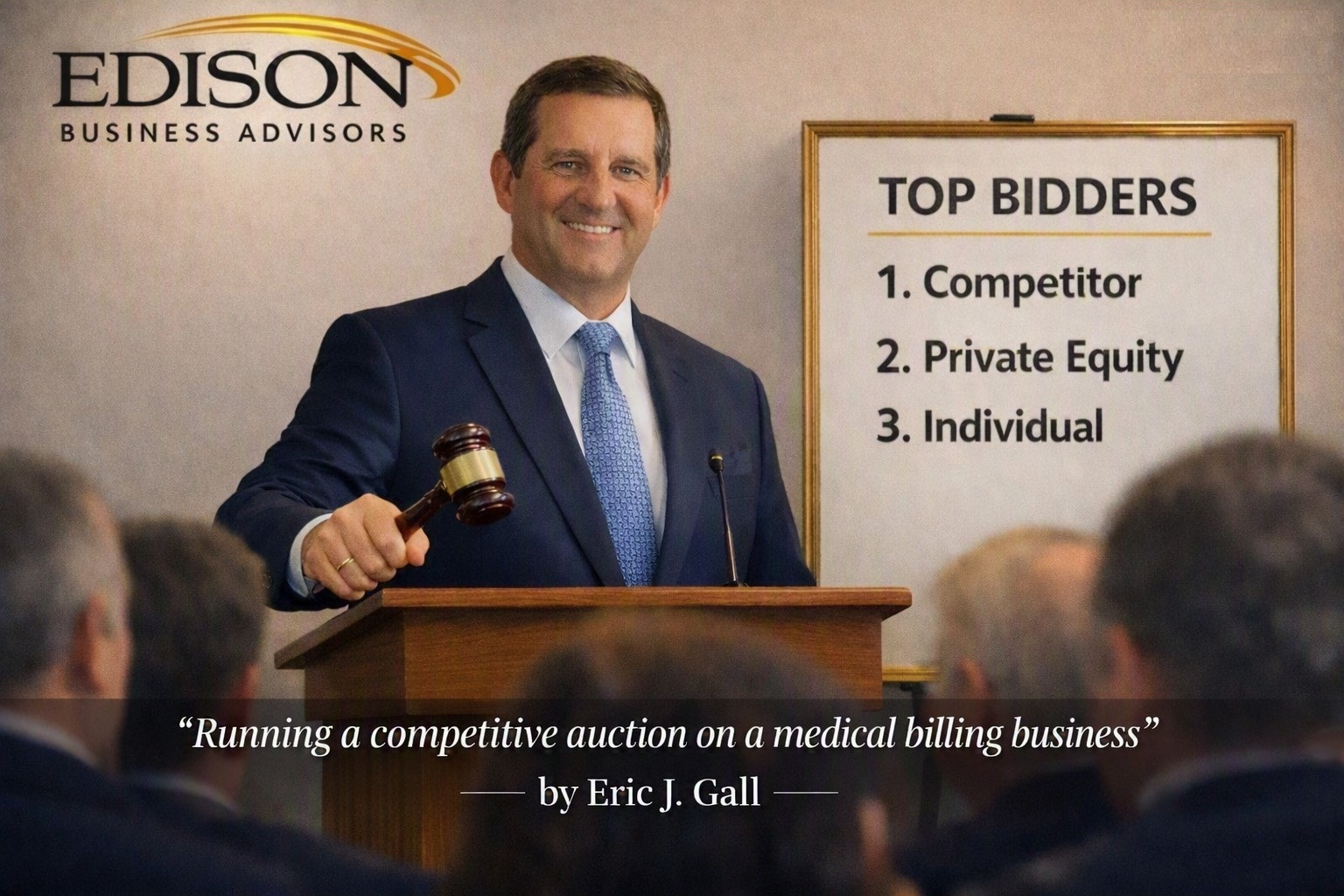
by Eric J. Gall
A Central Pennsylvania Medical Billing Business Goes to Market
Every seller wants a hot deal. That was the situation I walked into with a medical billing business based in central Pennsylvania — a well-run, profitable business built over two decades serving physician practices and small health systems across the region. When we quietly took it to market, I expected strong interest. Medical billing sits at a sweet spot for buyers: recurring, contractual revenue; sticky client relationships; a fragmented, roll-up-friendly industry; and a service that becomes more essential, not less, as payer rules and coding requirements grow more complex. What I received was interest on a scale I do not see often, even in a hot sector.
Within the first week, I collected more than 200 signed NDAs. By the end of the first month, that number passed 500. Six months in, we were north of 1,000 — an extraordinary figure for a lower-middle-market business that, on paper, looked like a hundred other regional medical billing businesses. My phone and inbox lit up just as fast. In week one alone, I personally fielded more than 60 direct requests for calls or meetings with the seller. By week two, that number nearly doubled to over 100. By the end of week two we already had 20 formal Letters of Intent (LOI) on the table, with several more clearly circling.
Overwhelming demand is not a problem to survive — it is a gift, and the raw material for the single best tool a seller has: competition. The mistake would have been to let that demand run wild, reacting to one-off requests as they came in and letting the loudest or most persistent buyers set the pace. Handled that way, high demand burns everyone's time and produces mediocre, inconsistent offers. Handled with structure, is exactly what drives price up and generates terms in the seller's favor. My job was not to calm the demand down. It was to give all of that demand energy somewhere organized to go. So that is what we built.
Step One: Log It, Do Not Chase It
I protected the seller from buyer calls in the beginning — not because we shut anything down, but because we never opened that door in the first place. Every inquiry that came in, whether it was a polite email or a fund principal calling my cell, was logged and received the same response: Thank you for your interest. Due to very high interest, we are building a structured process, please be patient, and everyone will be treated the same way at the same time. I fielded every one of those 60-plus request myself in week one, and I deferred every single one of them to patiently wait for the process to be developed and communicated.
That discipline mattered more than almost anything else we did. It meant no individual buyer received an informal read on price expectations before the structured process was outlined to them. It meant the seller stayed focused on running the business instead of fielding a dozen sales pitches disguised as relationship-building. And it set the tone from day one: this was going to be a competitive, structured auction, not a race to whoever reaches the seller first.
Step Two: Building a Real Auction
For every inquiry logged and buyer asked to wait, I designed a formal, timeline-driven auction — the kind of structured process I use specifically to turn very high interest into disciplined, comparable offers instead of a scramble. The framework looked roughly like this:
- LOI requirements published up front. Rather than accepting whatever format buyers wanted to send, I issued a clear guide of what an acceptable LOI needed to include — valuation, structure, financing contingencies, rollover expectations, and timeline to close. I also instructed them to provide me a defined list of documents and due diligence questions each buyer needed to work through before submitting their LOI. This did two things at once — it raised the floor on offer quality, and it filtered out anyone who was not serious enough to do their homework and prevented questions from coming in piecemeal.
- Centralized document management and review. All documents went through a single data room with tracked access, so I always knew who had looked at what, and no buyer could later claim they had been given incomplete information. Every question came back through me, was answered once, and — where appropriate — was shared with the full buyer pool so no one had an informational edge.
- A re-pen round. Once buyers had access to the requested documents and had their questions answered, they were invited to revise their LOI and resubmit — a "best offer for round one" step that let serious buyers sharpen their numbers with real information instead of guesswork.
- Seller review and a disciplined narrowing. The seller and I reviewed every resubmitted LOI together and narrowed the field down to the buyers we were genuinely comfortable moving forward with. There was no arbitrary cutoff number we were trying to hit — twelve is where we landed, but that number was a byproduct of the decision, not the goal. We weighed price, structure, certainty of close, industry fit, and given how sensitive billing and coding data is — how much we trusted each buyer's underlying intent. The twelve that advanced were invited to a buyer-seller conference call, the first time any buyer obtained direct access to the seller since the process began, and now on our terms, in a structured setting, and with an agenda.
- A final information request. After the calls, remaining buyers received one more window to request documents or ask clarifying questions before the next cut — ensuring no one could later claim they had been denied information that affected their offer.
- Down to four for site visits. From twelve, the seller and I narrowed the field to four finalists. Each was given an off-site meeting in State College, Pennsylvania, followed by a tour of the operation after business hours — a chance to walk the floor, see the facilities and equipment, and get a feel for the business, without disrupting staff or tipping off the team during the workday.
- Final LOIs and ranking. After the site visits, each of the four submitted a final LOI, and the seller and I each ranked them independently.
It is worth pausing here: this is exactly the kind of structure that separates a professionally run sale process from an ad hoc one. The goal of a controlled auction is not just to drive price — it is to create genuine apples-to-apples comparability, protect confidential information, preserve the seller's time and leverage, and make sure the winning bidder is winning because they are the best buyer, not because they were the most persistent caller.
Meet the Finalists
Before I walk through how the final round played out, it is prudent to introduce the three buyers who made it to the end, because who they were — and what was actually driving each of them — explains everything that happened next far better than the numbers on their LOIs ever could.
The easy cut. One of the four finalists was eliminated by mutual agreement almost immediately after the site visits.
The easy cut. One of the four finalists was eliminated by mutual agreement almost immediately after the site visits.
The individual buyer. This buyer came from inside the industry, with real, hands-on medical billing experience. The seller liked him for exactly that reason — he understood the business, spoke the language, and felt like someone who could step in and run it without a steep learning curve. The seller ranked him #1. I ranked him #3. The difference in our views came down to one thing: this buyer was funding the transaction with his own money and signing personal guarantees. Every dollar of risk in that transaction was going to land on him personally, and that changes how a buyer behaves once due diligence starts. Every ordinary bump and quirk becomes an amplified risk factor, and increased risk always erodes price.
The private equity buyer. This buyer brought institutional capital, a slick process of their own, and an aggressive opening price. Both the seller and I ranked this buyer #2. On paper, it was a strong, well-capitalized offer from a group that does this for a living. What we did not know yet — but should have expected, given how these groups often operate in competitive processes — was that winning the auction and actually honoring the price they won it with were treated as two separate events.
The strategic buyer. This buyer was a direct competitor in the medical billing space, and by a meaningful margin, they submitted the highest offer of the four finalists. I ranked them #1. The seller ranked them #3 — dead last — and for a completely understandable reason: the seller's biggest fear going into this process was not price, it was being used. A competitor sitting inside your data room, looking at your client contracts, your pricing, your staffing, and your operational playbook is a competitor who can walk away from a transaction having gained everything they needed to compete against you — without ever writing a check. That risk was real, and it is exactly the kind of thing a structured process must manage rather than ignore. What ultimately set this buyer apart was their focus: they were not asking generic due diligence questions, they were laser-focused on how efficiently the seller resolved billing and coding errors — a capability that speaks directly to realization rates and client retention, the two things that actually drive value in this business. That is not the profile of a buyer doing competitive reconnaissance. That is the profile of a buyer who was learning exactly what they were buying.
Where the Rankings Went to Die
A clean ranking on paper is only the beginning. What happened over the following months is a near-perfect case study in why disciplined process management matters even after a LOI is signed.
Seller's #1 stumbles. The individual buyer — the seller's top choice — moved into due diligence and immediately began dragging his feet: slow-walking document requests, pushing back timelines, generating the kind of friction I have learned to read as an early warning sign. Later in the process, he attempted to retrade the price. Exactly the pattern you would expect from a buyer whose own money and personal guarantee were on the line — the deeper due diligence went, the more real the risk felt, and the more he looked for a way to reduce it after the fact. He was terminated and replaced by the seller's second choice.
Seller's #2 makes the same mistake. Rather than my own top choice stepping into the vacancy, seller chose our #2, the private equity buyer. He also dragged-out due diligence and then attempted a retrade of his own. The excuses offered were thin, which was telling in itself: this was not a retrade driven by a genuine due diligence finding, it was a negotiating tactic that had likely been part of the plan since their original LOI.
Round two with seller's #1 — and a final retrade. Again, ignoring my recommendation to move to my #1, the seller reinstated the individual buyer. The buyer went back through negotiations, appeared to reach agreement on terms — and then attempted to retrade a second time. That was the end of the conversation. He was terminated for good.
My pick closes the deal. That left the strategic buyer — the competitor with the highest price offer, the one I ranked 1# from the start, and the one the seller had ranked last out of concern about giving a competitor a look inside the business. Once the seller's other two options had each shown their hand twice, that gave way to a buyer who never dragged their feet during due diligence, never floated a retrade, and was focused the entire time on the operational substance of the business rather than anything that looked like reconnaissance. The seller agreed to terms, and the transaction moved to closing efficiently — no drama, no delay, and no attempt to renegotiate what had already been agreed.
The Takeaway
Overwhelming buyer interest is a gift, but only if it is treated like fuel for a process rather than a fire to put out. A thousand NDAs and a hundred phone calls chased one at a time will exhaust a seller and muddy a negotiation before they receive a LOI. With a structured process, that same volume is exactly what creates real competitive tension, drives price, and reveals the best buyer.
The buyer who looked riskiest to the seller at the start of the final round — the competitor with access to sensitive operational data — turned out to be the only one of the three who never blinked. The two buyers the seller trusted more each received a chance, and each returned it. That is not a coincidence, and it is not really a story about bad luck with buyers. It is what a well-run auction is built to reveal: which offers are real, and which were never going to survive due diligence.
You can contact Eric Gall at 239.738.6227 or [email protected].
You can contact Eric Gall at 239.738.6227 or [email protected].



